Curious Incident of the Dog at Night Time Play Review
T he Curious Incident of the Dog in the Nighttime-Time is a bestselling novel that tells the story of Christopher Boone, a 15-yr-old male child who, later the vicious killing of his neighbor'due south canis familiaris, embarks on a investigation à la his hero Sherlock Holmes.
When it was first published in 2003, the book was promoted equally a glimpse into Asperger's syndrome. Author Mark Haddon later on disavowed the connection, perhaps because so many people with Asperger'due south objected to the portrayal of Christopher Boone.
Asperger'due south isn't mentioned in the novel itself: Christopher says he has "some behavioural difficulties". Simply his graphic symbol adheres to some common ideas about neuratypical people that are consort in movies such as Pelting Man: he has unusual mental abilities (he can instantly count a herd of cows outside a railroad train window, and has a precocious mathematical power) and he'due south unsettlingly devoid of empathy for other people.
The National Theatre's stage accommodation is the Melbourne Theatre Company's headline act for 2018. A lauded production that began in London'south Cottesloe Theatre and concluded upward playing seasons in the West End and Broadway, it has been brought to Melbourne by the MTC and Arts Centre Melbourne.
A much beloved bestselling book, adapted for the stage by a remarkable contemporary playwright for the National Theatre. What could possibly go wrong? As far as the rapturous opening night audience was concerned, not much. It was a hitting before it even opened, with the entire season sold out.
The product is an artfully conceived and skilfully manifested adaptation, which remains, as playwright Simon Stephens himself says, "loyal" to the book. This means that narrative and dialogue have been imported wholesale and given theatrical dress-ups. In that location's a stiff current of sentimentality that makes this very much a story for those on the outside looking in, which maybe has been exaggerated by the crudities of accommodation to the phase.
Like the book, the production is ingeniously conceived. The voice of Haddon's narrator is brilliant and intriguing, and the images interspersing the text have been translated past designers Bunny Christie (set), Paule Lawman (lighting) and Finn Ross (video) into visual spectacle, with a set that combines projections, drawings and boxes that tin be repurposed as unlike objects.
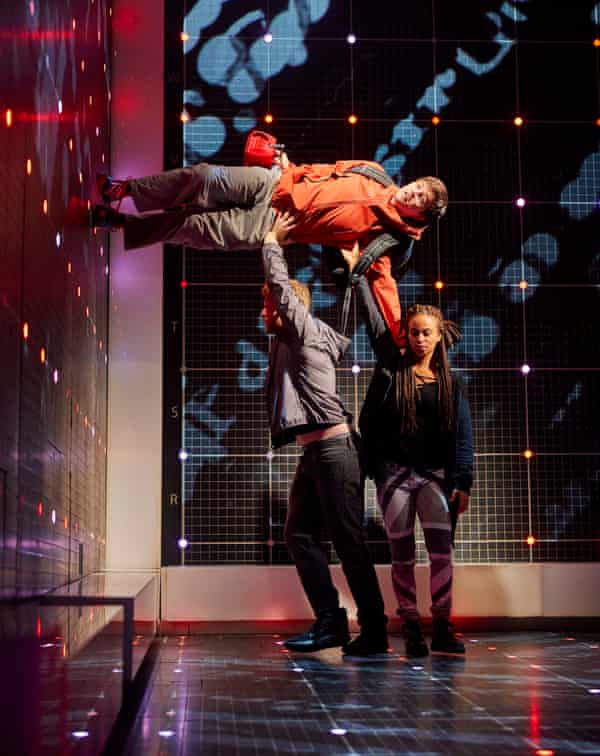
The cast consists of the four major characters, Christopher himself (Joshua Jenkins), his father Ed (David Michaels), his mother Judy (Emma Beattie) and his teacher Siobhan (Julie Hale), with all other characters played past the remaining half dozen cast members.
Marianne Elliott (also the director of the hit National Theatre show War Horse) creates a stylised performance that segues into physical theatre or dance, choreographed by Frantic Assembly's Scott Graham and Steve Hoggett. Actors become props – doors, for instance – in ways that irresistibly recalled theatre in education shows I saw in the 1990s. There's no denying it'south well done, but as a trope it likewise strikes me as curvation, contributing to a cutely self-conscious charm that begins to grate early on.
This stylisation creates a disconnect that exposes the emotional holes in the story. While the rough characterisations work fine for the minor characters, such every bit headmistress Mrs Gascoyne (Amanda Posener), it creates a dilemma with the major characters around Christopher.
The audience is supposed to empathise with his parents, Ed and Judy, who both struggle with the challenges of dealing with Christopher. However they are seldom more than than speculative sketches, heavily relying on cliche: the inarticulate father struggling with his own emotional problems; the mother who runs off with her dodgy lover, unable to cope with her son.
Presumably the characters that surround Christopher Boone are seen through his subjectivity. As he's unable to perceive them except as gross caricatures, that is what they become: ciphers who represent diverse behavioural mysteries. This means the emotional arc of the story is forced to rely on a heavy dose of sentimentality to power information technology past its more questionable aspects. Nosotros discover some deeply disturbing things virtually Ed, for instance, which are glossed over with a moment of shameless audience-pleasing awwwww that substitutes for any actual resolution.
Emotional verity is mostly replaced by spectacle, and this is definitely a very pretty bear witness. The design is at its most powerful when it conveys the panic of information overload when, for instance, Christopher travels through the London Surreptitious. But even the best effects irksome with repetition, and repetition is built into the dramaturgy in means that don't enhance it.
What interested me most virtually the production was its ingenious trouble solving, but that's inappreciably ballast for an entire evening. I couldn't help wondering what it might have been like had Simon Stephens been less loyal to the novel: the adaptation is finer an blithe book, rather than a translation into theatre, and so plays heavily towards audience expectations rather than surprise. But perhaps a more radical adaptation might accept alienated Haddon's fanbase.
Source: https://www.theguardian.com/stage/2018/jan/17/the-curious-incident-of-the-dog-in-the-night-time-review-spectacle-devoid-of-emotional-verity

Post a Comment for "Curious Incident of the Dog at Night Time Play Review"